
How Many m³ of Storage Do I Need? A Guide to Calculating Volume
Last updated: 31 July 2026 • 7 min readWhen we ask on the phone, "How much stuff do you have?", the answer we hear most often is: "About a truckload." A truck isn't a good unit of measurement. Whose truck, which truck? Storage prices are calculated per cubic meter; so, to put it plainly, the question "how many m³ of storage do I need" is really the question "how much will I pay each month." Rent too much space and you pay for empty air every month. Rent too little and the wardrobe ends up on top of the sofa; that's a whole other problem.
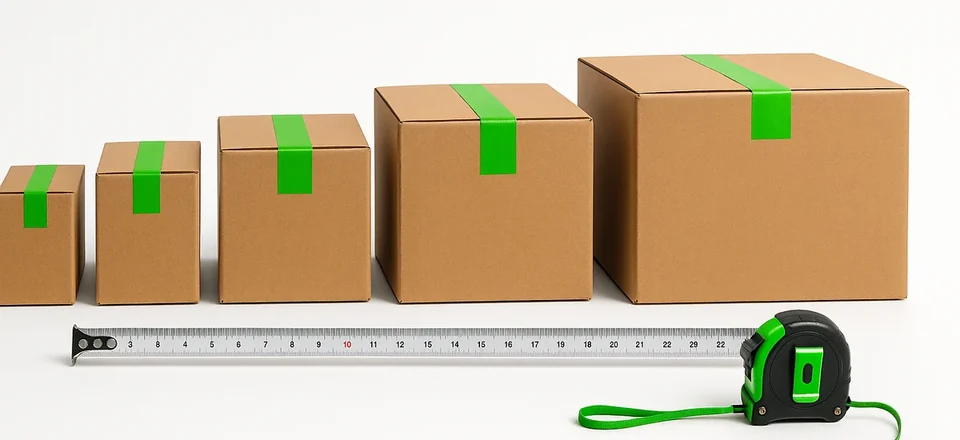
Key Takeaways
- Price is proportional to cubic meters; estimating volume correctly means money stays in your pocket.
- Roughly: a one-bedroom home takes up 10-15 m³, a two-bedroom 15-25 m³ and a three-bedroom 25-35 m³.
- Ten standard moving boxes come to about 1 m³.
- Disassembling the bed frame, table and wardrobe reduces volume noticeably.
- Photos give a rough estimate; the exact figure comes from a free on-site survey.
How Much Space Is a Cubic Meter?
Picture a box one meter wide, one meter long and one meter high. That's 1 m³. If that doesn't help, think of it this way: twice the size of a large washing machine. When volume is calculated in storage, it's the packed size of an item that counts, not its bare size. The box walls, the stretch wrap, a blanket on top; each adds a few centimeters. A few centimeters doesn't seem like much. Add it up across thirty items and it's a different story.
A Rough Estimate by Number of Rooms
The exact figure comes from the on-site survey; that's a separate matter. But you have to start somewhere when planning, and the table below is that starting point. Let's say it up front: most two-bedroom homes take up less space than their owners expect.
| Home Type | Approximate Volume | Typical Contents |
|---|---|---|
| Studio | 5-8 m³ | Bed, small wardrobe, a few boxes |
| 1 bedroom (1+1) | 10-15 m³ | Bedroom, living room set, appliances |
| 2 bedrooms (2+1) | 15-25 m³ | Furniture for two rooms, kitchen, appliances |
| 3 bedrooms (3+1) | 25-35 m³ | Three rooms, living room furniture, all appliances |
| 4 bedrooms (4+1) / Villa | 35 m³ and up | Multi-room furniture, garden furniture |
With villas and detached houses, this calculation goes off. A garden table, two bikes, whatever's been forgotten in the basement; the volume suddenly balloons. For moves like that, see our article on villa household storage.
Adding It Up Item by Item
If you want a closer figure, grab a pen and paper and walk through your home. Here's roughly how much space common items take up once packed:
- Double bed and base: 2-2.5 m³
- Three-door wardrobe, disassembled: 1.5-2 m³
- Three-seater sofa: 1.5-2 m³
- Refrigerator: 0.8-1.2 m³ (depending on size)
- Washing machine or dishwasher: 0.5-0.7 m³
- Disassembled dining table with 6 chairs: around 1.5 m³
- Standard moving box: 0.1 m³; so 10 boxes make 1 m³
The sneakiest item on the list is the wardrobe. If it isn't disassembled, it takes up nearly twice as much space as when it is. A single wardrobe can make a difference of one and a half to two cubic meters; that's a difference that shows up on your bill every month.
Estimating from Photos
Can't be bothered to make a list? We get it, we wouldn't want to either. Send a photo of each room to Troyi and let it give you a rough cubic-meter figure. To be clear, this isn't a price quote; it's just a first look that answers the question "should I be thinking 10 m³ or 20?" Exact measurements are taken during the free on-site survey.
Where Do People Go Wrong Most Often?
In four places. In our experience, the first two are the most common mistakes.
Forgetting the packing allowance. Boxes and stretch wrap add about 10% on top of the total. People who measure their bare furniture and show up at the storage facility with that number are surprised at the door.
Counting items that can be disassembled as whole pieces. Volume drops significantly when the bed frame, table and wardrobe are taken apart; people who calculate with them assembled end up renting a bigger unit than they need.
Not counting the odds and ends. Books. The contents of the kitchen cabinets. Sheets, towels, coats. These fill more boxes than expected, and always at the very end, in the evening.
Not taking height into account. In storage, items are stacked on top of each other. Anyone who looks only at floor area rents more space than they need.
You Have Your Number. What's Next?
Let's say your cubic-meter figure is settled. That leaves two decisions: the storage type and the neighborhood. If you'll drop by every now and then to pick something up, go with a private room; if your plan is "leave it and pick it up months later," container storage is more affordable. We explain where the two differ in our article what is a rental storage unit.
The current table of monthly rates by cubic meter is on our household storage prices page.
Tell us your volume, and we'll find the right storage unit and price for you: use the free quote form or call 0850 888 66 15.
Frequently Asked Questions
How many m³ do the contents of a one-bedroom home take up?
Generally 10-15 m³ once packed. The more bulky items such as a refrigerator, sofa or wardrobe there are, the closer the figure gets to the upper limit.
Should I calculate the volume myself?
For a rough estimate, just tell us the number of rooms. Exact measurements are taken during a free on-site survey. You can also get a preliminary estimate by sending photos to Troyi.
What happens if I rent a storage unit bigger than I need?
Since the price is proportional to volume, you pay every month for space you don't use. The opposite is a problem too: in a small space, items get crammed on top of each other and the risk of damage increases.
Do I need to disassemble the items I'm putting into storage?
It's not required, but taking apart the bed frame, table and wardrobe reduces volume noticeably. Disassembly and reassembly can be included in the service. You can also find approximate volumes by number of rooms on our household goods storage page.

