
A Guide to Storing Baby and Kids' Items
Last updated: 19 August 2026 • 5 min readIt's a scene we see often: a two-bedroom apartment in Ümraniye, the child has just turned two, the crib has been taken apart and put on top of the wardrobe, the travel cot is on the balcony, and there are three boxes of "outgrown" clothes in the hallway. That's how baby gear is. It piles up fast, gets used briefly, then just sits around. If a second child is somewhere in the back of your mind, it's a shame to get rid of it all; but there's no room to keep it at home either. That's exactly the point when most families call us.
Key Takeaways
- All of a baby's belongings, including the crib and stroller, usually fit into 2-4 m³.
- Car seats have a service life set by the manufacturer; a seat that has been in an accident should never be used again.
- Anything with batteries has its batteries removed, no exceptions.
- Invisible milk stains turn yellow within months; remove stains before storing clothes.
- For textiles stored longer than 6 months, use breathable cloth bags instead of vacuum bags.
What You Can Store and What You Shouldn't
Easy to store
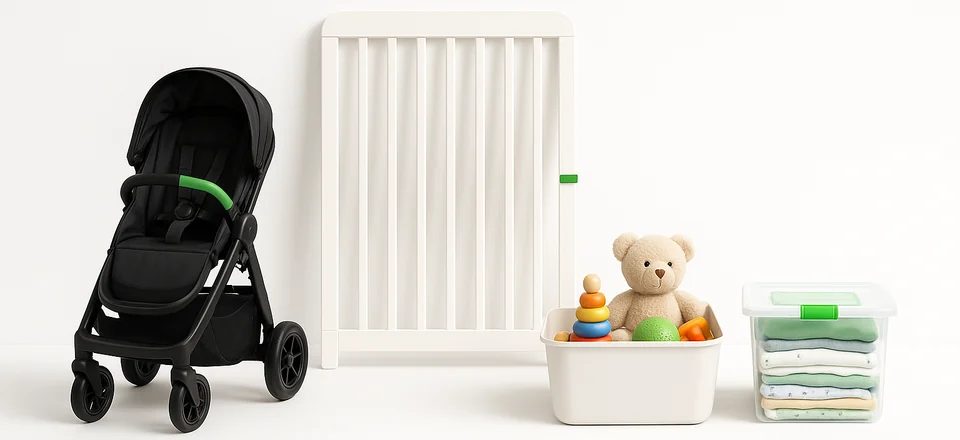
Cribs, travel cots, high chairs. A stroller that has been cleaned and thoroughly dried. Wooden and plastic toys, washed clothes and blankets, books, educational materials. No problem with any of these; they go into storage, wait for years and come back out.
Items that need attention
- Car seat: Manufacturers set a service life, and a seat that has been in an accident is not reused. Check the manufacturer's information before putting it into storage; otherwise, you'll end up paying for space for a seat that's useless three years later.
- Battery-operated toys: The batteries come out. A leaking battery ruins not just that toy, but everything in the same box.
- Pacifiers, bottles, feeding bowls: For hygiene reasons, we don't recommend reusing them after they've been stored for a long time.
Cannot be stored
Baby food, formula, any food at all. This isn't a preference, it's a rule; food is the number one cause of pest infestations in storage. The full list is in our article on what can be kept in storage.
Before Storage: Hygiene Steps
- Wash or wipe down everything. Milk, food and drool residue is an open invitation to both mold and insects.
- Dry everything completely. In our experience, this is the most common mistake: packing a fabric item because it's "not really damp."
- Remove the batteries.
- Bag the small parts. Crib screws, high chair attachments, spare parts; put them in a bag and tape it to the main item.
- Label everything. Something like "0-6 months clothes" or "crib parts." When your second child arrives, you won't have to dig through box after box.
The Right Way to Store Clothes
The most common complaint with baby clothes is yellowing. It's usually caused by a milk or food stain you can't see; it oxidizes over time and shows up as a yellow mark when you take the clothes out. So remove stains before storing, because it doesn't work afterward. For bags, use breathable cloth bags or cotton covers. Vacuum bags save a lot of space, true; but when fabric goes months without air, yellowing can speed up. If it's going to be more than 6 months, use cloth bags. Also sort and label by size; we'll come back to this below.
How Much Space Do You Need?
All of a baby's belongings usually come to between 2-4 m³. Roughly broken down: a disassembled crib is 0.5-1 m³, a stroller 0.5 m³, and boxes of toys and clothes 1-2 m³. If the nursery wardrobe and bed are going too, it goes up to 5-8 m³. For your own belongings, see our guide on how many m³ of storage you need.
Controlling Moisture and Odor
Moisture is the enemy of textiles and plastics. There are three simple precautions: put a moisture absorber inside closed boxes, keep items off direct contact with the floor and choose a climate-controlled storage facility. That's it. The details are in our article on moisture, mold and pests in storage.
Sorting by Age Group
With baby gear, the real time loss isn't when you put it into storage; it's when you can't find the right box for your second child. The solution is simple: group items by the age they're used at. The 0-6 months group includes newborn clothes, the infant carrier and the baby bathtub. The 6-12 months group is the high chair, playpen and crawling-stage toys. And 1-3 years is the baby walker, larger toys and toddler bed. Put each group in separate boxes and write the age range on the outside. When the time comes, only that box gets opened, and the rest stays put.
Add Seasons to the Mix
For clothes, the age range alone isn't enough. The same size comes in winter and summer versions; a double label like "6-12 months / winter" noticeably shortens search time. For the complete labeling system, see our article on labeling and numbering boxes.
Short Term or Long Term?
If it's unclear whether or when a second child will come, start short and extend. The minimum term is 1 month; you can move out in any month you like, and there's no deposit. The details are in our article on monthly rental storage.
If you'd like your belongings picked up from your door, which most families who'd rather not squeeze into an elevator with a crib and travel cot do, take a look at the storage with door-to-door pickup option. For a quote, you can reach us here or call 0850 888 66 15.
Frequently Asked Questions
Can a stroller and car seat be stored?
A stroller can easily be stored once it's been cleaned and dried. A car seat has a service life set by the manufacturer, and a seat that has been in an accident should never be used again; check the manufacturer's information before putting it away.
How should I store baby clothes?
Washed, completely dry and in a breathable cloth bag. Vacuum bags save space, but fabric that goes without air for a long time can turn yellow.
What should I do before putting the crib and toys into storage?
Clean them and dry them thoroughly. Mold grows on plastic and wooden surfaces that stay damp. Bag the screws and small parts and tape them onto the main item.
How much space do I need?
All of a baby's belongings, including the crib, stroller, toys and clothes, usually take up 2-4 m³.

