
How to Pack Glass and Fragile Items
Last updated: 5 August 2026 • 5 min readYou arrive at your new home, lift a box and hear that faint jingle from inside. It's the worst sound of any move: broken plates. Here's what moving crews have seen for years: glass and porcelain don't break because they fall off the truck, but because they rattle around inside the box. Or because they're stacked on top of each other. Both come down to wrapping and placement, which means they're entirely in your hands.
Key Takeaways
- Most broken plates don't come from drops but from shifting around inside the box and being stacked the wrong way.
- Plates shouldn't be stacked flat; stand them upright, side by side, like books.
- Put an X of tape across a mirror's glass and it stays in place; even if it breaks, the pieces won't scatter.
- Mirrors and paintings always travel upright and are always stored upright.
- Newspaper is cheap, but its ink can leave marks on white porcelain and light-colored surfaces.
First, a Test: Shake the Box
Hold the box you've just sealed with both hands and shake it gently. Do you hear rattling? If so, that box isn't ready to go. That rattle will accompany every brake and every speed bump on the way, and at the destination it'll be called "broken." Wrapping is half the job. The other half is leaving no empty space.
Plates: Line Them Up Like Books
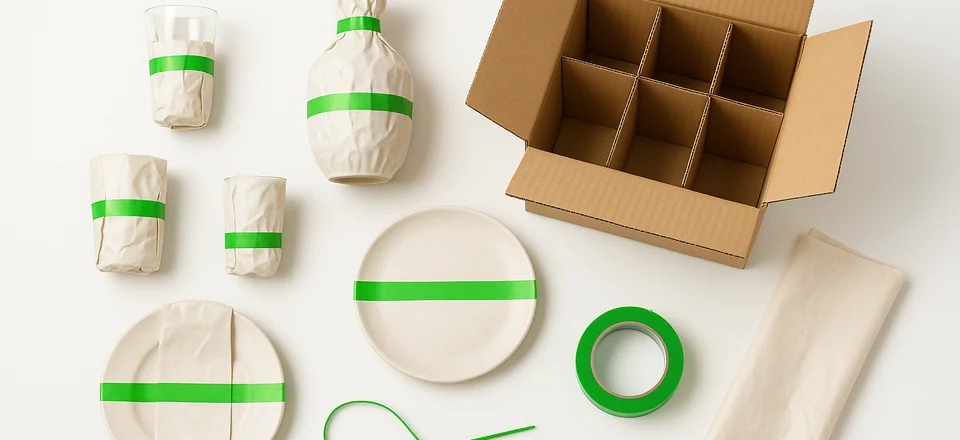
Say it's Saturday morning and you have a roll of packing paper on the kitchen table and the dinner set you've taken down from the top cupboard. Wrap each plate individually in paper. Then stack them in twos or threes and wrap them in another layer; now you have small bundles. Here's the critical part: don't lay these bundles flat in the box; stand them upright, side by side, like books. When a plate stands on its edge, it carries the load from above along its rim, and that's when it's strongest. Line the bottom of the box with something soft first, and do the same on top.
Stuff crumpled paper into any remaining gaps.
The most common mistake we see? Stacking plates flat on top of each other. The plate at the bottom can't bear the weight of those above it; by the time the box settles into place, it's already cracked.
Glasses and Stemware
Don't leave the inside of a glass empty; fill it with crumpled paper. Wrap the outside, with a slightly thicker layer around the rim, because that's where impacts always land. On stemmed glasses, the weakest point is the thin waist where the bowl meets the stem; give it an extra layer. Place them upright in the box, rim facing up.
Mirrors, Paintings and Glass Surfaces
First, tape an X across the mirror's glass, corner to corner. The tape holds the glass in place; if it does break, the pieces stay together instead of scattering everywhere. Cover it with packing paper, put bubble wrap or corner protectors on the corners, then sandwich it between two pieces of cardboard. And let's say this up front: a mirror is always moved upright and always stored upright. Lay it flat and the glass is strained under its own weight. We explain how to wrap bubble wrap so it actually works in our article on how to use bubble wrap.
Newspaper or Packing Paper?
Packing paper (also called wrapping paper) is ink-free and leaves no marks. Newspaper is cheap and usable. But printing ink can rub off onto porcelain and light-colored ceramics. Don't use newspaper at all on white porcelain and marble surfaces; dealing with those stains takes longer than the wrapping itself.
Choosing a Box
For fragile items, use small boxes. Fill a big box with plates and whoever carries it will lose their balance. Choose double-wall (double-layer corrugated) boxes. Tape the bottom twice; the bottom is where a box most often gives way, and usually while someone is carrying it.
Labels Are a Must
Write "FRAGILE" in big letters on the outside of the box, and "DO NOT STACK" next to it. Nobody opens boxes to check while loading the truck; without a label, the box of plates ends up under the laundry basket. If you want to set up a system, our article on labeling and numbering boxes has you covered.
Items the Standard Method Can't Handle
Some glass can't be wrapped like a plate. An oven door has double glazing, and the real damage comes from the hinge; tape the door to the body of the oven and cover it with a blanket. Remove a glass coffee table top from its legs, move it separately and keep it upright in storage too. On display cabinets and cupboards with glass doors, remove the glass doors if they come off; if they don't, secure them from the inside with tape, or they'll swing open on the way.
Chandeliers are a story of their own: remove the crystals one by one and number them, because the order matters when you put them back.
Where Should It Go in Storage?
If you wrap everything perfectly and then put the box at the bottom of a pile in storage, all that effort is wasted. There are three rules: fragile boxes go on top, nothing goes on top of them, and they don't touch the floor (they sit on a pallet). For this to work, the box must say "FRAGILE" and "DO NOT STACK"; that's the only way the person placing it can tell. For a labeling system, again see our article on labeling and numbering boxes.
If It Will Stay in Storage a Long Time
For glass and porcelain that will sit in storage for months, the real danger isn't breakage. It's humidity and dust. Keep boxes closed, keep them off the floor and drop a moisture absorber inside. Details are in our article on humidity, mold and pests in storage.
If you'd rather not deal with it, leave the wrapping and moving to our team; fill out the free quote form or call 0850 888 66 15.
Frequently Asked Questions
Should plates be packed flat or upright?
Upright, side by side like books. In that position, a plate handles the load from above much better. In a flat stack, the ones at the bottom crack under the weight.
Can I use newspaper?
You can, but printing ink can rub off onto porcelain and light-colored surfaces. Packing paper is ink-free and leaves no marks; use it for white porcelain.
How should I move a mirror?
Tape an X across the glass from corner to corner; the tape holds the glass in place, and if it breaks, the pieces won't scatter. Then always move it upright, keep it upright in storage too, and never lay it flat.
What should I use to fill empty space in a box?
Crumpled packing paper, leftover bubble wrap, or soft fabric like towels or T-shirts; whatever you have on hand. Just make sure nothing rattles inside when you shake the box.

