
What Is Household Storage?
Last updated: 14 October 2026 • 4 min readHousehold storage means keeping items you're not currently using at home or at work in a secure, dry and controlled storage facility for a period of time. Your belongings are usually picked up from your door, packed, moved to the facility and returned in the same condition whenever you ask. The monthly fee is based on the volume your belongings take up and the location of the facility.
The need often arises unexpectedly: an urban renewal (earthquake-driven redevelopment) decision is made, a renovation begins, the handover of a new home is delayed or a job offer comes in from abroad. Instead of selling your belongings, giving them away or leaving them in a damp basement, storing them means you'll find them just as you left them when you return. In this guide, we explain how household storage works, which type of storage suits which belongings and what to look for when making your choice. You can find the service itself on our household storage page.
What Does a Household Storage Service Do?
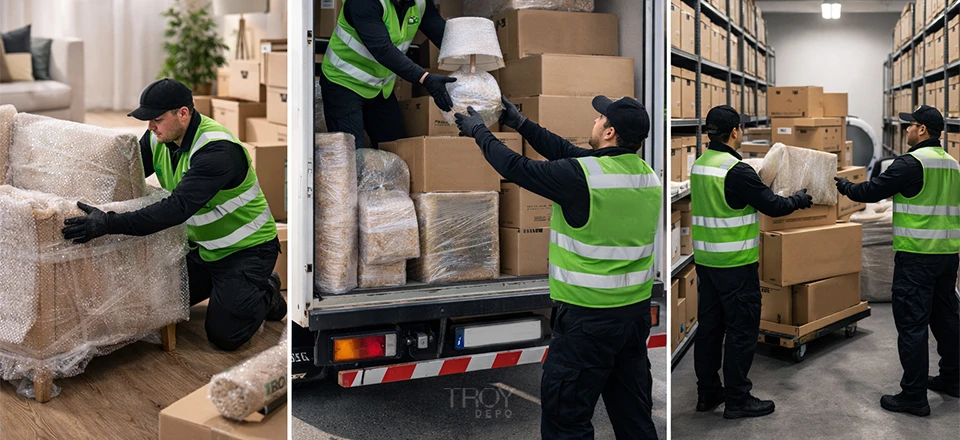
Renting storage doesn't mean piling your belongings into an empty room. Professional household storage is an end-to-end process that covers the on-site survey, packing, moving, placement in the facility and optional insurance. We also cover the scope of the concept in our article what is a rental storage unit.
The Difference Between Full-Service Storage and Self-Storage
With self-storage, you rent the storage space; packing, moving and placement are entirely up to you. With full-service storage, your belongings are picked up from your door, packed and placed in storage by a team. Commonly known as a storage hotel, this model is especially advantageous for the contents of an entire home and heavy furniture, saving time and reducing the risk of damage.
Who Needs Household Storage?
- People going through urban renewal: When a building is being rebuilt, the home has to be completely emptied; you'll find the process and our recommendations on our urban renewal storage page.
- People renovating: Leaving your belongings at home during painting, new flooring or a kitchen remodel means exposing them to dust and knocks.
- People between two homes: When the move-out date from your old home and the move-in date for your new one don't line up, your belongings need somewhere to wait in between.
- People moving abroad and students: Those closing up their homes for a few months or years.
- Businesses: Companies looking for space for an office move, archives or off-season stock.
You can find detailed information for homes on our home goods storage page and for businesses on our office storage page.
How Does Household Storage Work?
The process consists of four steps and is usually handled by a single team.
1. On-Site Survey and Cubic Meter Calculation
First, the type and quantity of your belongings are assessed and the volume they'll take up is calculated. The right volume keeps you from paying for more space than you need and prevents your belongings from being crammed in. If you'd like to do the math yourself, check out our guide how many m³ of storage do I need. At Troy Depo, the on-site survey is free.
2. Packing and Moving
Furniture is disassembled and wrapped in protective blankets; glass and porcelain items are packed one by one, and boxes are numbered with a contents list kept on file. You'll find practical packing tips in our article how should I pack my belongings, and an explanation of how door-to-door pickup works in our article storage with door-to-door pickup.
3. Placement in Storage
Belongings are arranged with heavy pieces at the bottom and fragile items on top; boxes you're likely to need often are kept near the door. This arrangement saves time whenever you want to retrieve something from storage.
4. Return Delivery
When you're ready, just give us a date. Your belongings are moved to the address of your choice, and furniture can be reassembled on request. We explain the details of the move-out process in our article how belongings are taken out of storage.
Types of Storage: Which One Suits Which Belongings?
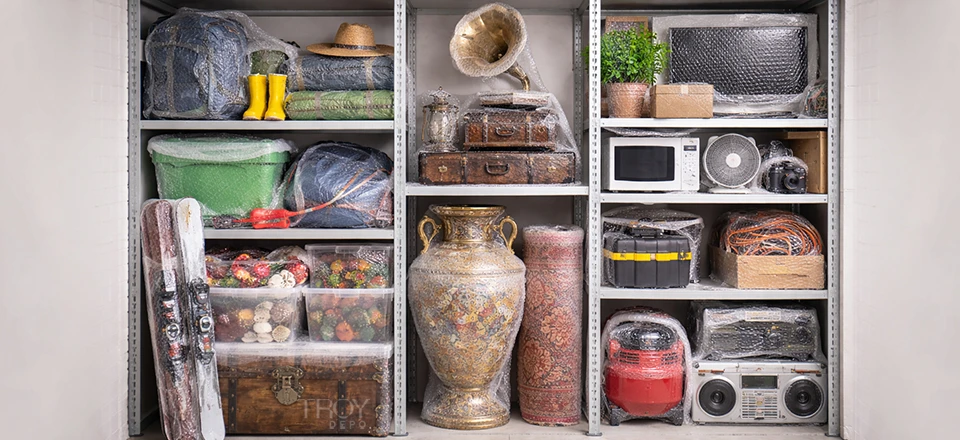
Choosing the right type of storage directly affects both the cost and the safety of your belongings. The key question behind the choice is this: will you need to access your belongings while they're in storage?
Private Room Storage
Storage in a locked room that belongs to you alone. You can visit your unit during business hours to pick up any box you need or add more items. Room sizes range from small spaces that fit just a few boxes to large rooms that can hold the contents of an entire home. It's the best option for anyone who will need to access their belongings from time to time. Details: private room storage.
Container Storage
Your belongings are placed in a closed container that usually stays sealed throughout the storage period. Access is limited and available by appointment; in return, it's more affordable than a private room. It's ideal for items that won't be touched for a long time. Details: container storage. For very large volumes, there's also the high-ceiling HC container option.
Shelf and Pallet Storage (Business)
Space for boxes, archives and product stock is rented by the shelf or pallet. For this model, mostly preferred by businesses, see our business storage page.
If you'd like to compare the two main options side by side, our article private room vs. container storage will make your decision easier.
The Advantages of Household Storage
More Space and Order at Home
When items you don't use go into storage, your home feels more spacious and your workplace gains room to work. During a renovation or move, you no longer have to shuffle your belongings from room to room.
Security and Protection
Our partner facilities meet Troy Depo Standards, with security, CCTV and alarm systems, climate control and pest control. In long-term storage, the real risk is humidity-related mold and odors, which is why humidity-controlled spaces are the top choice for wooden furniture and textiles. For more on this, take a look at our article humidity, mold and pests in storage.
Optional Insurance
If you'd like extra protection for your belongings against fire, flooding and theft, insurance is added to your quote. We explain the coverage and terms in our article insured household storage.
Flexible Terms
Storage is rented monthly; the minimum term is 1 month, and it can be extended for as long as you need. You don't have to commit to a long term up front.

How Are Household Storage Prices Determined?
Two main factors determine the monthly fee: the volume your belongings take up and the location of the facility. Naturally, there's a big difference between a few boxes and the contents of a three-bedroom home. If you want moving, packing and insurance, these are shown as separate items in your quote, so you can see exactly what you're paying for from the start. For current price ranges and a breakdown of each item, see our article household storage prices.
What to Look for When Choosing a Household Storage Service
- Facility conditions: Is there security, CCTV, climate control and pest control? Can you see the facility?
- Insurance: Which risks are covered, and which are excluded? Is the policy provided in writing?
- Transparent quote: Are storage, moving and packing listed separately? Are there any extra fees that might come up later?
- Access: Is it clearly stated when and how you can access your belongings in storage?
- Inventory: Is there a process in which boxes are numbered and you're given a contents list?
For a more comprehensive checklist, see our article questions to ask when choosing a storage company.
Frequently Asked Questions
Are household storage and renting a storage unit the same thing?
They're similar, but not the same. When you rent a storage unit, you only rent the space; a household storage service can also include packing, moving and placement.
What is the minimum storage period?
Storage is rented monthly, and the minimum term is 1 month. You can extend your contract for as long as you need.
Can I access my belongings in storage?
With private room storage, you can visit your unit during business hours. With container storage, access is limited and available by appointment.
Which items can't be stored?
Flammable and explosive materials, perishable food, live plants and pets are not accepted for storage. You'll find the full list in our article what can be kept in storage.
Where is household storage available?
Troy Depo works with more than 20 partner facilities in Istanbul, Kocaeli, Ankara, Izmir, Bursa and Antalya.
Get Started with Household Storage
Whether you want to free up space at home, get through a renovation with ease or bridge the gap between two homes without a hitch, the first step is a free on-site survey. Fill out the form, and we'll work out the volume of your belongings together and prepare a personalized quote for you.