
Going Remote: Where Does the Office Furniture Go?
Last updated: 20 August 2026 • 6 min readSay you run an eight-person software office in Maslak, the lease ends at the end of the month, and everyone has been working from home for months anyway. The desks are still there. So is the conference table. So are the server cabinet in the corner and the invoice binders that have piled up over the years. It's one of the questions we hear most often on the phone: "What do we do with all this?" Selling is easy but there's no going back, and taking it all home is usually physically impossible. A conference table simply won't fit in a living room.
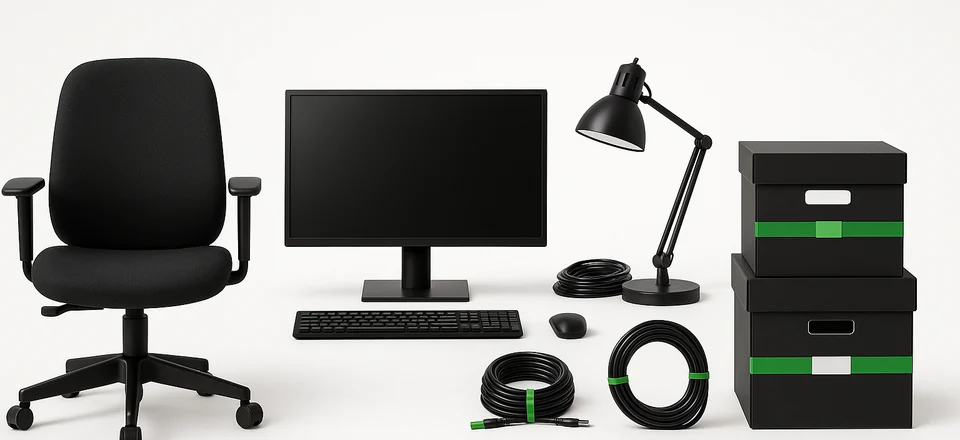
Key Takeaways
- Office contents aren't one big pile; furniture, equipment and archives need to be considered separately because each requires different conditions.
- With archives, the decision isn't up to you: there are legal retention periods, and humidity control plus a log of who accessed what and when are essential.
- The furniture and equipment of a 5–10 person office take up roughly 15-25 m³.
- 20 standard archive boxes come to about 1 m³.
- The cost of a few years of storage usually comes in below the cost of setting everything up again from scratch.
Three Groups of Items, Three Different Decisions
Let's be clear from the start: there's no single thing called "office stuff." There are three separate groups, and each has a different answer.
1. Furniture
Desks, chairs, cabinets, the conference table. Expensive to buy again. If there's any chance you'll return to an office someday, even just two days a week, keep it; if not, sell it and be done.
2. Equipment
Computers, monitors, printers, servers, network devices. Both valuable and temperamental: humidity and temperature swings are bad for them. Don't even consider anything other than a climate-controlled space.
3. Archives
Accounting ledgers, contracts, personnel files, invoice binders. Here, "should we keep them?" isn't really a question; there are legal retention periods, and until they run out, those papers have to be kept somewhere.
Archives: The Most Critical Part
If someone shows up one day and says "show us the contracts from a few years ago," you need to be able to produce them. That means the paper has to stay intact and be findable. Archive storage comes down to three things: humidity control (paper absorbs moisture fast; it yellows first, then grows mold), an access log (who took which box on which day) and a proper boxing system. Hunting for a single invoice in forty unnumbered boxes is, frankly, an afternoon we wouldn't wish on anyone. For details, see our article on archive and document storage.
How Much Space Do You Need?
Roughly: a single workstation with its pedestal drawer unit and chair takes up 1.5–2 m³. The furniture and equipment of a 5–10 person office come to 15-25 m³. A standard archive box is 0.05 m³, so 20 boxes make one cubic meter. For a more precise calculation for your own office, there's our guide on how many m³ of storage you need.
What to Do Before Storage
Don't underestimate this; set aside an afternoon before anything goes into storage.
- Take inventory. Who has which laptop, which desk is going to storage? Compare it against your fixed asset list.
- Back up your data. Any computer going into storage should be backed up first; if possible, remove the drives and store them separately.
- Box and number the archives. Keep the contents list on a separate sheet; the outside of each box should only show a number and a short title.
- Disassemble the desks. Volume drops by almost half, which means you pay less every month.
- Label the cables. The biggest time sink when setting up again is trying to remember which cable goes where.
Which Storage Model Is Right?
If you'll need to get into the archives now and then (month-end close, an audit, a lawsuit), private room storage is the right choice; you can visit as often as you like by appointment during business hours. If you're only leaving the furniture long-term, in other words, if you're saying "I won't touch it for a year," container storage is cheaper.
If you need a larger-scale setup with shelving and pallets, the corporate storage service page is for you.
Tracking Equipment Handed Out to Employees
When an office closes, some of the laptops and monitors go to employees' homes rather than to storage. A situation we see often: six months later, nobody knows who has which monitor. During handover, fill out a written equipment assignment form for each device with its serial number and delivery date. Keep the equipment in storage and the equipment at people's homes in the same spreadsheet; two separate lists will stop matching after a while. Keep license and warranty documents separately from the devices, in digital form.
The Possibility of Going Back to a Hybrid Model
Some companies that go fully remote return to the office a few days a week within a year or two. That possibility makes the decision to sell risky. Setting up again isn't just a furniture bill; between choosing, ordering, waiting for delivery and assembly, weeks go by.
In our view, the most sensible approach is this: keep the core furniture, get rid of the rest. The conference table, the cabinets and lightly used desks are worth keeping. Paying storage fees every month for a chair with a wobbly armrest and an old monitor makes no sense.
Cost Comparison
The math is simple. On one side, write down the cost of buying the furniture again; on the other, the storage fees you'll pay over the period you have in mind. In most cases, a few years of storage comes in below setting up from scratch, and with quality, lightly used furniture the gap gets even wider.
How to Get Started
All we need is the office address, which floor you're on and a rough inventory. Our team comes for an on-site survey and takes care of packing and transport. You can fill out the free quote form or call 0850 888 66 15.
Frequently Asked Questions
Does it make more sense to sell office furniture or store it?
If there's a chance you'll return to hybrid work, store it; setting up again usually costs more than a few years of storage. If you're sure you won't go back to an office, selling is more economical.
Can I keep company archives in storage?
Yes. Accounting ledgers and business documents have legal retention periods, and they must be physically preserved until those periods expire. Choose a space with humidity control and logged access.
Can computers and server equipment get damaged in storage?
They can if there's no humidity and temperature control. They should be stored in a climate-controlled space, in their original boxes or wrapped in bubble wrap.
How many m³ does office furniture usually take up?
The furniture and equipment of a 5–10 person office take up roughly 15-25 m³. Archive boxes are added on top of that.

